
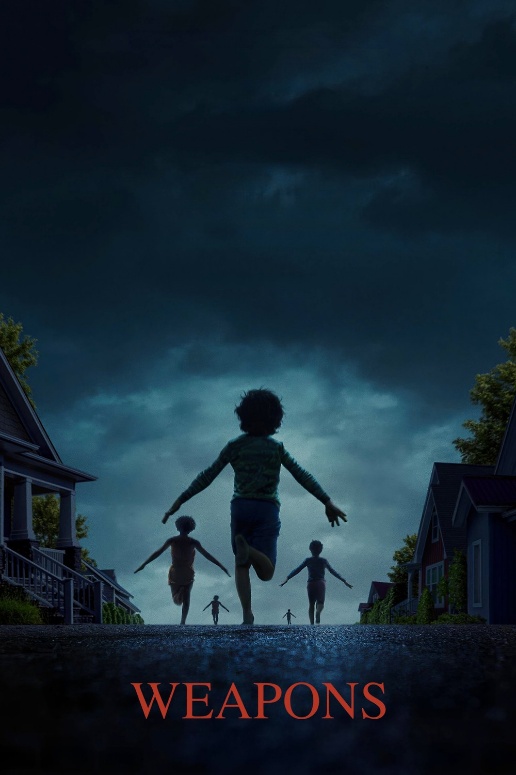
 In this essay, I argue that the movie Weapons (2025) is a latent critique of radical transgender ideology, particularly its barbaric application to children and its associated violence (e.g., Trantifa, trans-related school shootings, etc.). Whether this critique is the subtle intention of the film’s writer/director Zach Cregger or is an unconscious byproduct of his art, Weapons channels our society’s collective anxiety over the trans issue.
NOTE: This essay contains spoilers.
Suburban Horror
Much has been written about the horror film genre being a coded and subversive critique of straight, White, “patriarchal” suburban America. This writing has come almost entirely from the cultural Left and is quite often of the Marxist or Freudian variety, or a fusion of both. (Postmodernist film analysis is among the most execrable writing one will find). Among this crowd, Robin Wood’s 1979 essay “An Introduction to the American Horror Film” is quite influential.[1] Drawing on Freudian and Marxist ideas, Wood argues that American horror films dramatize the tensions and “repressions” underlying bourgeois capitalist society. He proposes that horror narratives revolve around the return of the “repressed Other” — figures or forces symbolizing what the dominant society “excludes” or suppresses (e.g., sexuality, female autonomy, racial differences, youth rebellion). In this reading, the monster or threat embodies these repressed elements, while the central conflicts in the plot reflect society’s attempts to contain or destroy these repressed elements. Wood interprets the horror genre as a cultural barometer: when purported social contradictions intensify, horror films become more subversive, revealing anxieties about the fragility of the family, authority, and the suburban ideal at the center of American life. In a widely-quoted line from Wood’s essay, he writes: “At this stage it is necessary to offer a simple and obvious basic formula for the horror film: normality is threatened by the monster.”
In what can be called suburban horror or suburban gothic, some films attempt to subvert the American suburban life ideal in particular or, more generally, middle-class life itself. Relevant motifs include the fear of the neighbor/stranger next door; isolated or emotionally distant characters; the uncanny in familiar domestic spaces; anxieties about reproduction and parenthood; and the aforementioned consequences of “sexual repression” beneath middle-class conformity. And so we have Leftist exegeses on such films as Psycho (1960), Night of the Living Dead (1968), The Exorcist (1973), It’s Alive (1974), Carrie (1976), Eraserhead (1977), Halloween (1978), The Brood (1979), Poltergeist (1982), A Nightmare on Elm Street (1984), The Babadook (2014), and Hereditary (2018).
But sometimes the interpretive tables can be turned. Wood and his ilk are correct that films can act as a cultural barometer, an intuiting of the zeitgeist. With respect to many of the culture war issues of our time, the Left currently has institutional hegemony (e.g., schools, government, media, etc.) despite lack of majority support from the public, and right now there is widespread public anxiety over the issue of minors sexually transitioning, particularly in how schools, the medical establishment, and the courts can collectively strip decisions over such matters away from parents.[2]
The zeitgeist itself is the conscious self-image of an age — its collective attitudes and dominant symbols — plus the unconscious compensation for what that age represses. Carl Jung theorizes that each of our individual psyches contains an unconscious reservoir of motives, desires, fears, beliefs, and other characteristics that we have suppressed from our conscious mind. He furthermore believes that insofar as certain elements of one person’s unconsciousness are shared by others — that is, as part of a collective psyche — we then have the second-order dynamic of the collective unconsciousness, which Jung demarcates through his schema of archetypes. In the same way that an individual has a Shadow, an entire culture can likewise possess a collective Shadow. The path to psychological health, according to Jung, is the individuation process, and the first step of that process involves encountering one’s Shadow and attempting to integrate its components into the ego. This cycle of individuation then repeats itself continuously as a person matures through adulthood.
It is in this context that the symbolism found in works of art can be studied, interpreted, and appreciated. Works of art that — however indirectly or subconsciously — touch upon the individuation dynamic will resonate. Whether it is through movies, music, literature, or other artforms, Jung’s unconscious Shadow archetype expresses itself as the antithesis of whichever personality type is the dominant, actualized, conscious zeitgeist of the day. “Whatever the unconscious may be,” Jung writes, “it is a natural phenomenon producing symbols that prove to be meaningful” (Jung, 1964). Of the very nature of a symbol, he writes: “By this I do not mean an allegory that points to something all too familiar, but an expression that stands for something not clearly known and yet profoundly alive” (Jung, 1933). Elements of the Shadow are encountered in creativity and can act as a sublimated expression of this encounter. Oftentimes, the artist is not consciously aware that his work is accomplishing this. Great art that engages with this dynamic is able to resonate with a wide swathe of society, tapping into those elements of the collective unconscious most in need of resolution, broaching unresolved tensions of the conscious and unconscious minds, and ultimately providing a step towards psychic integration. With respect to a society’s well-being, Jung believes that the more primordial elements or visions an artist gives expression to can have a salutary effect upon the psychically unbalanced situations the society is experiencing.
Aunt Gladys
Writer/director Zach Cregger’s surprise hit film Weapons centers on the mass disappearance of 17 third-grade children from the same classroom in a small Pennsylvania town. All vanished at precisely 2:17 a.m. on the same night, in a synchronized exodus from their respective homes. Only one child from the classroom, Alex Lilly (Cary Christopher), remains behind.
Rather than moving events in a straight line, Cregger divides the film into character-driven chapters. The narrative unfolds by jumping back and forth in time through these chapters, rotating the perspectives of several key characters.[3] Weapons contains several themes revolving around the trauma of inexplicable loss, forms of addiction, and scapegoating, but a closer symbolic reading reveals a latent critique of radical transgender ideology, its application to children, and its associated violence.
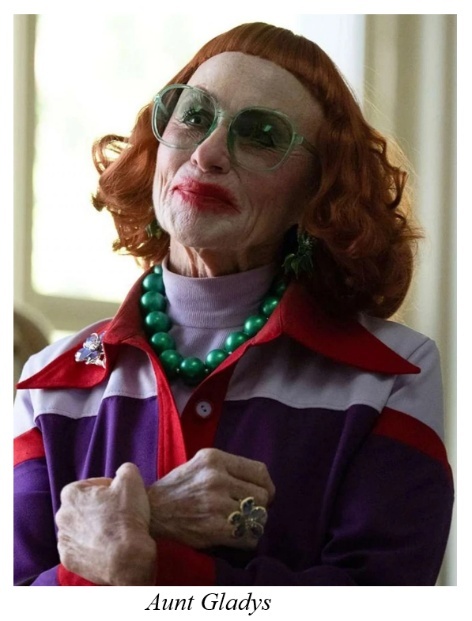 At the heart of this interpretation lies Aunt Gladys (Amy Madigan), the film’s ruthless antagonist. Gladys is a malevolent witch with ulterior motives who, presenting as Alex’s old and long-absent aunt, inserts herself into Alex’s home life after the disappearances. (Alex has never met her before).
She appears to be suffering from an incurable illness (or else is unnaturally old), and the film’s supernatural premise suggests that she uses witchcraft to restore her health and prolong her life. By obtaining a victim’s hair or another personal belonging, she can place them in a trance-like, near-catatonic state and bend them to her will. She then exploits these victims, especially the children, as a source of vitality, effectively feeding on their life force to rejuvenate herself. In addition, by stripping individuals of their agency, she turns them (whether children or adults) into obedient zombie-like “weapons” who attack on command.
Gladys is heavily queer-coded in appearance and demeanor: garish outfits with all the colors of a rainbow flag, camp theatricality, drag-queen aesthetics, and an exaggerated, almost performative femininity. Interestingly, she only talks with this performative cadence when in public. Privately, when she is back at Alex’s house, with her wig off, her voice is lower, measured, and more natural. Gladys’ overall presence and effect can be seen as an example of the uncanny, one of the horror genre’s most unsettling devices in both literature and film. The concept is most famously associated with Freud’s influential 1919 essay “The Uncanny” (one of Freud’s better moments), where he analyzes the psychological roots of the feeling, believing it can be traced to repressed fears and the blurring of boundaries between animate and inanimate, familiar and strange. The uncanny operates less through the alien or monstrous, and more through the distortion of the familiar: the home that no longer feels safe, the doll that almost looks alive, a smile that goes a little too wide. What makes it effective as a horror device, and what the better elevated horror filmmakers understand, is that it doesn’t ask the audience to fear something foreign, but asks them to fear something they already know and love, albeit something that is now slightly wrong. In other words, the horror isn’t located in the thing itself but in the gap between what it should be and what it has become, and that gap — that ‘wrongness’ — is often harder to make sense of than a straightforward monster. With the uncanny, the familiar world is thrown into disarray rather than being intruded upon from the outside. An aspect of the closely related unreliable narrator device often comes into play as well: one never really knows if the noise a character hears, or something he thinks he sees in a flash, is really there or whether it is part of his overexcited or paranoid imagination. The uncanny in Gladys’ unsettling appearance mirrors the uncanny in our own real-world encounters with many transgender individuals, where we are supposed to ‘perceive’ the biological male who decided he wants to be a woman… as an actual woman.
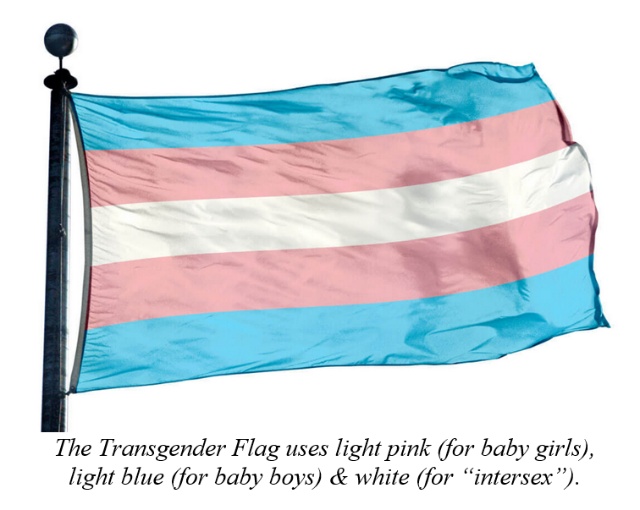 Given Gladys’ unambiguous malevolence (which includes murder), it is rather odd (or perhaps not) that her character has become something of a camp LGBTQ+ icon. In a NYT piece by Esther Zuckerman titled “Aunt Gladys From ‘Weapons’ Doesn’t Scare These Drag Artists,” several drag queen performers who have adopted the Gladys persona in their acts are interviewed:
Perla said that drag queens were drawn to Gladys because she is something of a drag queen herself. When she’s at home, Gladys is makeup-less, casting spells in a nightgown. “But when she’s interacting with people throughout the film and she’s fully done up in this caricature of herself, there is such a difference between her private persona vs. her public persona, and I think that resonates with a lot of drag artists,” Perla said.
From this same piece, another drag performer expresses kinship with Gladys:
Capulet explains that, despite Gladys’ evil actions, she resonates for queer viewers beyond just her fabulous looks. “She’s an outsider trying to fit in with this weird society, and society kind of accepts her but not really and that’s gay people,” she said.
Another volunteers the well-worn ‘girl power’ trope:
[DeJa Skye] added that drag queens were drawn to Gladys because “we love a strong female.” She continued, “For me, it was just the fact she was not afraid to wear the cosmetics, she was not afraid to be camp, to be outlandish, to be out there and just to be, well, I guess not herself, quote-unquote, but what she wanted to present to the world.”
Still another hopes that Gladys lives forever in the drag queen world:
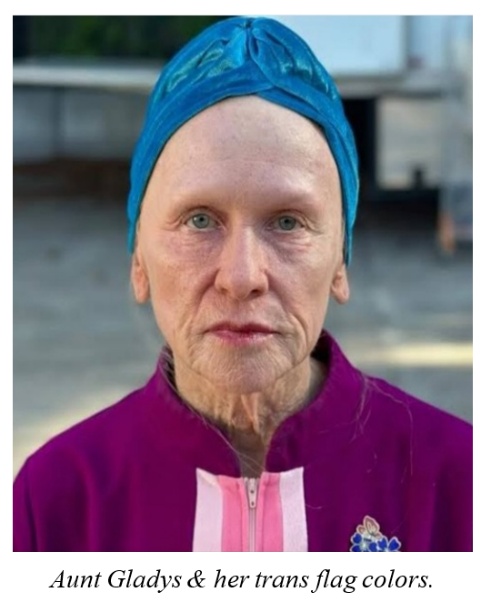 In Gouda Judy’s act, she imagines that Gladys survives the gruesome end of “Weapons.”
“I like to live in a delusional world where I get to see her one more time onscreen,” Gouda Judy said. “So I’m letting her survive through me and I’m sure a bunch of other drag artists are the same where she will live forever now as a drag icon.”
Amy Madigan, whose performance as Gladys has received an Oscar nomination for Best Supporting Actress, concurs:
“I love that the gay community has so taken to Gladys, and they realize she’s somebody that is an outsider, that’s tormented, that doesn’t fit in. And also her look. People just said, ‘Yeah!’ It’s just a surprise to me that the community, and I think people in the drag community too, kind of really related to [her]” (Chichizola, 2025).
In Weapons, Gladys is deceitful and manipulative and exerts a supernatural control over both children and adults. It’s important to note the striking visuals of the children running away from their suburban homes (i.e., the nuclear family) in the middle of the night (while their parents are asleep) and together racing to Gladys (i.e., trans ideology). With their minds controlled, the possessed children run in a synchronized, trance-like state — arms outstretched in a pointed, ritualistic form – as seen on the film’s promotional poster.
This running-in-unison serves as a metaphor for the associated brainwashing – the mind virus — that comes with woke indoctrination of children on the topic of transgenderism. Regarding these missing children, Gladys has effectively usurped parental authority, isolated the children from their families, and then proceeds to use them to pursue her agenda. Collectively, these sequences of the children running elicits a parallel with how transgender ideology and its proponents effectively lure or “steal” children away from their traditional family units.
Elsewhere in the film, a secondary character named James, who is a young homeless drug addict (and who will ultimately come under Gladys’ spell), steals a child’s backpack from an unlocked car and heads to the local pawn shop to unload its contents, all of which are in trans pink and blue.

At one point in the film, after she puts Alex’s mother and father into a catatonic state, Gladys sits at the head of the family’s dinner table, with the catatonic parents seated on each side of her, waiting for Alex to enter the room. The symbolism here is that Gladys (representing trans dogma) is in control, and not Alex’s parents. We can also perhaps see this dinner table scene symbolizing the mother/father divide on the issue of transitioning a child, the sociological phenomenon of fathers being more resistant to the idea than mothers.
Gladys then says to Alex: “Now, when I tell you that you are not to speak about me or your parents to anyone… you understand what can happen if you break your promise. I can make your parents hurt themselves. I can make them hurt each other. I can make them eat each other if I want to.” One can’t help but see a corollary here with teachers and school administrators hiding a student’s gender dysphoria from their parents, of indirectly encouraging the child to keep their transitioning a secret from their parents. (Many blue states have actually passed laws not requiring teachers or school officials to inform parents if a student identifies as a different gender at school).
Gladys has the missing children spellbound and holed-up in the basement of Alex’s suburban house, standing in unison as if in an alternative classroom, and she has placed newspapers over all of the house’s windows, furthering the theme of hiding the trans agenda from parents. Gladys has turned the children into her personal ‘weapons’ against those who threaten her plans. Should the need arise, she has the possessed children under her control to carry out whatever malevolent deeds she needs done. This motif of an adult figure indoctrinating, grooming, and coercing a group of impressionable youth into militant action against imagined enemies, in many ways echoes the ideological conformity mechanisms of transgender activists and the spate of violence in the past several years committed by transgender activist shooters, or in the case of Charlie Kirk’s assassination, a trans-adjacent shooter. This violence is very much the result of framing rational dissent against the transitioning of minors – against the “gender affirming care” that involves puberty blockers followed by cross-sex hormones — as being fascist ‘existential violence’ worthy of violent pushback.
AWFLs & Homosexuals
Of the affected third-grade classroom, the single holdout, Alex, becomes the pivot point: the child who resists or is spared the full ‘infection’, and who facilitates the truth surfacing. This echoes conservative critiques arguing that ‘gender-affirming care’, very much a social contagion phenomenon, pressures youth into irreversible steps (with unknown long-term effects on the still-developing brain) and also sidelines those with detransition narratives or who otherwise oppose the Trans-mania driven largely by AWFLs.
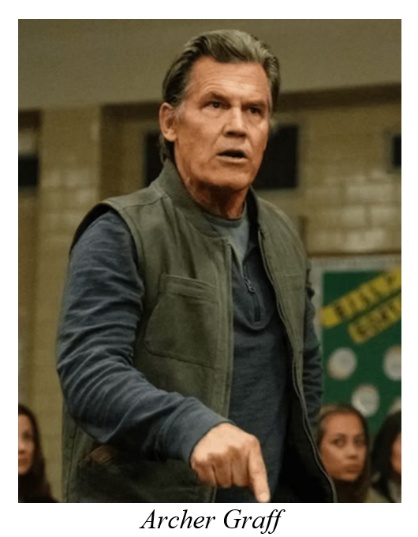
On this last point, a telling scene involves Archer Graff (Josh Brolin), a blue collar, conservative-coded, alpha male whose son is among the 17 missing children. Increasingly upset with the police department’s lack of progress in the missing children’s case, Archer takes it upon himself to research the overall case. He marks the locations of the homes from which the children have gone missing onto a map and, where he can, proceeds to review Ring camera footage from nearby houses for the night the children went missing. From this footage, he is able to see the direction the individual children run in, and using a triangulation method he posits the general area where the children’s rendezvous point might be converging at. At one of the homes of a missing child, however, Archer meets unexpected resistance from the child’s mother. She refused to allow Archer to review the family’s Ring footage. Not giving up, Archer waits in his car just down the street until the woman’s husband pulls into the driveway. Archer then approaches him and instantly agrees to let Archer review the Ring footage. As Archer is reviewing the footage with the husband, we see the wife lingering in the doorway, with arms crossed and a look of disapproval. Might this be alluding to how White mothers seem to be the most fanatical proponents of gender-transitioning their children, and White fathers the biggest detractors?[4]
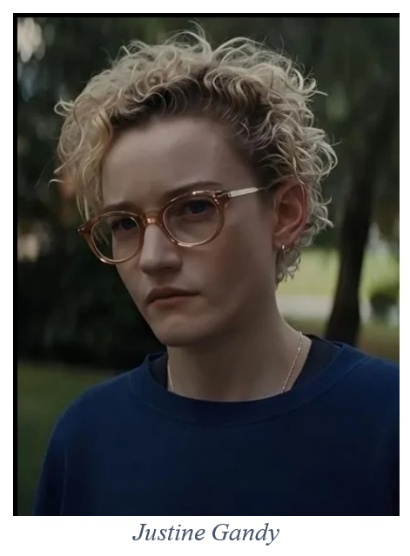 The scapegoating of teacher Justine Gandy (Julia Garner) further layers this allegory. Justine is the dedicated teacher of the missing children (and Alex). She is young, White, unmarried, and lives alone. Although her heterosexual promiscuity is depicted in the film, at first glance she could easily pass as lesbian or, at a minimum, feminist or the stereotypical AWFL public school teacher. As one lesbian reviewer of the film notes:
She isn’t, as far as the text shows us, queer, but it sure is easy to map her experiences and position in the film onto what it’s like to be a queer or trans teacher today. As part of their multi-level attacks on public education, the religious right has demonized LGBTQ+ teachers (Upadhyaya, 2025).
Justine is blamed by the community for the disappearances — in the way that, in our current cultural climate, teachers would be logical suspects in how and why someone’s child “decides” to become trans — and at one point in the film we see Archer use red paint to emblazon her car with the word “Witch”. Despite no evidence that she knows something about the children’s disappearances, she is placed on leave by the school’s principal Marcus Miller (Benedict Wong). Now completely ostracized, Justine’s alcoholism spirals, accompanied by other self-destructive behavior.[5]
Marcus is conspicuously depicted as homosexual, yet this seems to serve no ostensible purpose. (For instance, we see him and his effeminate husband Terry in the grocery store interacting as they pick out cereals and such). At Justine’s urging, Marcus visits Alex’s family home to inquire about young Alex. Gladys meets him at the door and successfully deflects him, but Marcus grows suspicious. Gladys picks up on this and decides he must die. She eventually visits the home of Marcus and Terry, invites herself in, and activates a spell on Marcus. In the following grotesque sequence, Marcus (under Gladys’ control) kills Terry, knocking him down to the kitchen floor, and then smashing Terry’s head repeatedly with his own forehead while spewing an ungodly stream of black bile onto Terry. Gladys then sends Marcus to kill Justine, who has been investigating Alex’s home life.
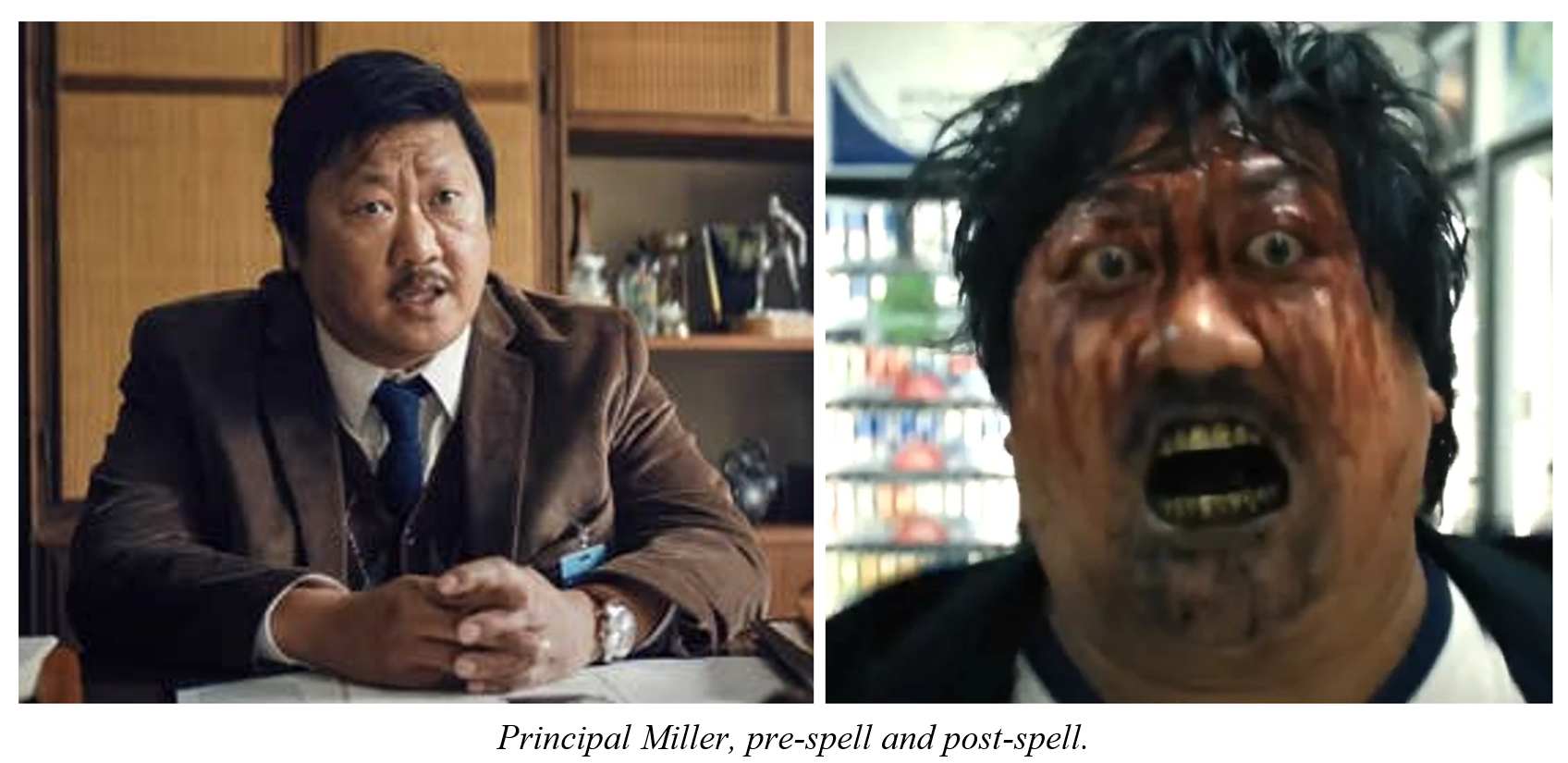
Insofar as we accept the notion that Gladys represents radical transgender ideology, her taking control of Marcus turns him into a symbolic agent of trans ideology itself. Gladys’ instructing Marcus to murder his husband Terry represents the escalating animosity that the thoroughly intolerant, radical trans community has towards ‘traditional’ homosexuals and feminists who believe in the biological gender binary, which is an issue dividing the LGBTQ coalition.[6] The black bile that Marcus spews onto Terry is akin to the relentless stream of screeched moral indignation and demands from the trans community that is taking place within this coalition’s political environment. Furthermore, with Gladys also suspicious that Justine (representing feminism) is getting close to the truth, she instructs Marcus to find and kill her. In other words, radical trans activism, its institutional ascent (especially in schools), and its intolerance for dissent has led some gays, lesbians, and feminists to turn on each other. These dynamics are articulated by Andrew Sullivan in his NYT opinion piece from 2025 titled “How the Gay Rights Movement Radicalized and Lost Its Way”. Sullivan is an influential culture critic and gay rights advocate whose politics could best be described as center-right-with-libertarian-leanings. Of the radical transgender agenda, he writes:
[It] was no longer primarily about gay, lesbian and transgender civil rights, because almost all had already been won. It was instead about a new and radical gender revolution. Focused on ending what activists saw as the oppression of the sex binary, which some critical gender and queer theorists associated with white supremacy, they aimed to dissolve natural distinctions between men and women in society, to replace biological sex with gender identity in the law and culture and to redefine homosexuality, in the process, not as a neutral fact of the human condition but as a liberating ideological queerness — which is then meant to subvert and queer language, culture and society in myriad ways.
The words ‘gay’ and ‘lesbian’ all but disappeared. L.G.B.T. became L.G.B.T.Q., then L.G.B.T.Q.+, and more letters and characters kept being added: L.G.B.T.Q.I.A.+ or 2S.L.G.B.T.Q.I.A.+ (to include intersex, asexual people and two-spirit Indigenous people). The plus sign referred to a seemingly infinite number of new niche identities and, by some counts, more than 70 new genders. The point was that this is all one revolutionary, intersectional community of gender-diverse people and intertwined with other left causes, from Black Lives Matter to Queers for Palestine…
But this new ideology, I believed, was different. Like many gays and lesbians — and a majority of everybody else — I simply didn’t buy it…
[A]bolishing the sex binary for the entire society? That’s a whole other thing entirely. And madness, I believe. What if I redefined what it is to be heterosexual and imposed it on straight people? Or changed what it means to be a man or a woman, for that matter? Then it ceases to be accommodation of a minority and becomes a society-wide revolution — an overreach that would soon lead to a potent and sane backlash, against not just trans people but gay men and lesbians as well” (Sullivan, 2025).
Sullivan notes how the ‘live and let live’ liberal equality goals of the gay rights movement suddenly began to clash with LGBTQ groups who, per their stated revolutionary goals, rapidly permeated the relevant institutions, including schools:
They demanded that the entire society change in a fundamental way so that the sex binary no longer counted. Elementary school children were taught that being a boy or a girl might not have anything to do with their bodies and that their parents had merely guessed whether they were a boy or a girl when they were born. In fact, sex was no longer to be recognized at birth — it was now merely assigned, penciled in…
Sullivan argues that in the gay rights movement, “there had always been an unspoken golden rule: Leave children out of it.” (To what extent this is true is certainly debatable). But for trans activists, targeting children has been a critical front in their culture war:
So what did the gender revolutionaries go and do? They focused almost entirely on children and minors. Partly because the adult issues had been resolved or close to it and partly because true cultural revolutions start with the young, it meant overhauling the education not only of children with gender dysphoria but of every other kid as well.
In a nightmare dream sequence that Justine has, she enters her classroom and sees all of her students sitting at their desks with their heads down. Alex, the one student who didn’t disappear, raises his head and gives a sinister smile with his face covered in creepy clown-like makeup, conjuring Gladys’ own garish appearance. This could be seen to symbolize the fear that certainly some teachers must have that a young boy in their classroom decides he is a girl.

Anxiety Over Trans Violence
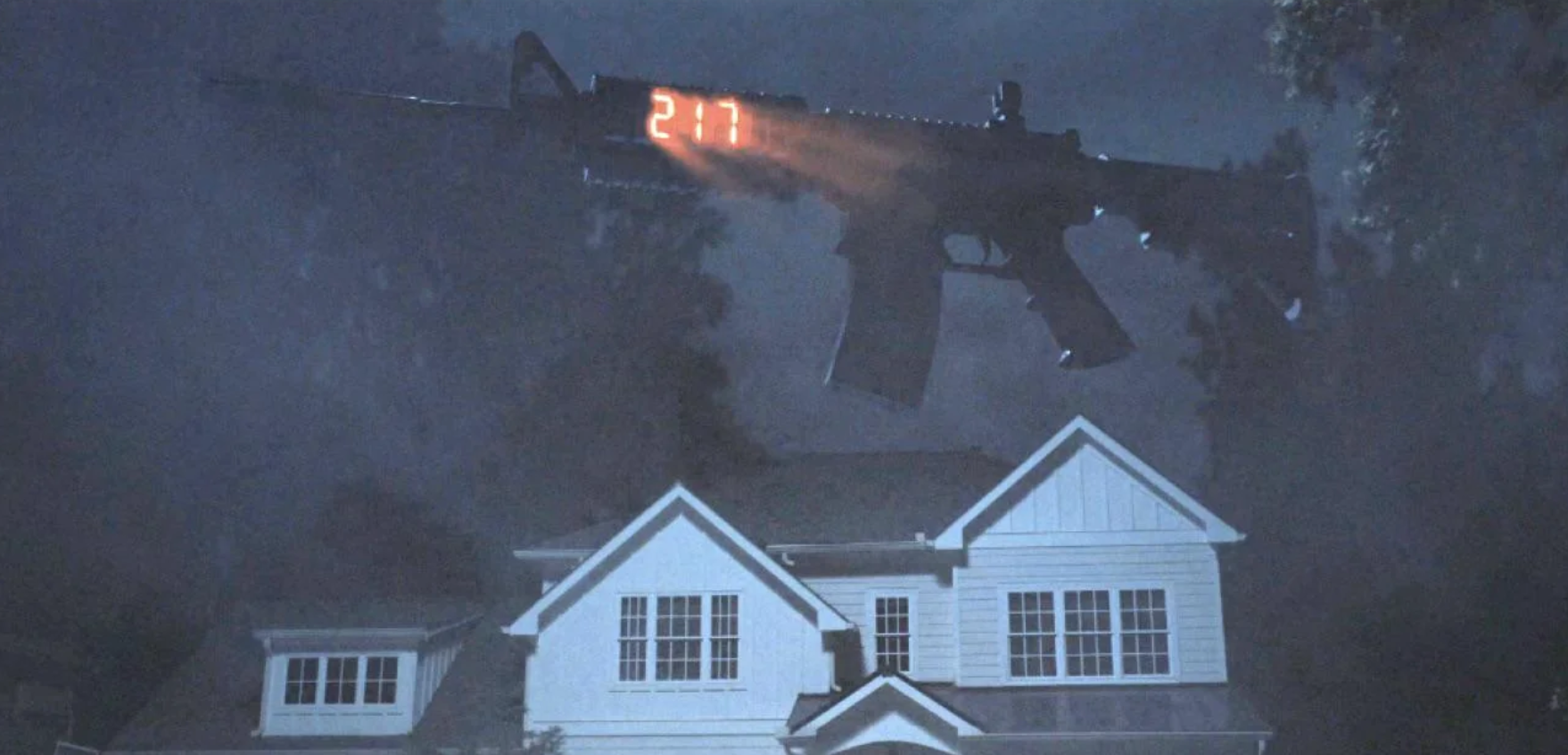
Within another nightmare dream sequence that Archer has about his missing son, a giant AR-15 is seen floating in the sky over his house, with “2:17” (the time the children all simultaneously disappeared) illuminating from it. Cregger has stated that he intentionally left the moment ambiguous and doesn’t give a definitive meaning for it:
It’s a very important moment for me in this movie, and to be frank with you, I think what I love about it so much is that I don’t understand it. I have a few different ideas of what it might be there for, but I don’t have the right answer. I like the idea that everyone is probably going to have their own kind of interaction or their own relationship with that scene, whether they don’t give a shit about it and it’s boring, or whether they think it’s some sort of political statement, or whether they think it’s just cool. I don’t really care. It’s not up to me. I just like that it’s there (Earl, 2025).
That being said, when combined with the very title of the film and the premise involving young schoolchildren, one cannot help but read the image as representing parental fear of school violence.
Sanity Prevails
Bioleninism (“Biological Leninism”) is a useful shorthand formulation for the Dissident Right’s view on how society operates.[7] It provides an encapsulating framework that centers upon, and synthesizes, various core perspectives within the Dissident Right: HBD realism; Steve Sailer’s “Coalition of the Fringes” notion; Moldbug/Yarvin-style historical revisionism (rejection of the progressive account of history) and accounts of hierarchy; memetics; and the critical role that status anxiety plays in radically remaking the centers of power in Western society. Because post-industrial affluence in the West has met the material needs of even the poorest and most low-status groups, class consciousness has failed to materialize as a Leftist rallying point. In its place is status, a prime motivator of human activity.[8] In brief, Bioleninism is the ideologically driven elevation of low-status groups into positions of power in the ruling class. However, unlike Lenin’s unified and formal Communist party of the Soviet Union, today’s Bioleninism is distributed and informal. There is no single unifying political party, but rather Gramsci’s “Long March through the Institutions” in the form of HR departments, NGOs, media, academia, corporate DEI… and public schools. Each act as a conduit of propaganda and activism.
The progressive regime today is largely comprised of an identity-based coalition of groups, and this has become the central organizing principle for its nexus of power. As such, this regime elevates people who would be low-status in a purely meritocratic, traditional, or naturally ordered (biologically determined) society — basically anyone who would rank low on natural hierarchies of competence, attractiveness, health, and traditional family formation. Groups that get uplifted and granted institutional power include non-White ethnic groups (particularly Blacks and Browns); LGBTs and people with other deviant sexualities; those with various other psychological disorders (“neurodivergence”); etc.
Along the way, the gender dysphoria underlying transgenderism goes from being a mental disorder to being normalized, a point of pride, even something to aspire to. This leads to an elevated moral status, a heightened sense of moral self-righteousness. The progressive coalition members become fanatically loyal enforcers (“political commissars”) precisely because their elevated position depends entirely on the continuation of the progressive regime model itself. If merit, tradition, or natural status hierarchies were to return — if the progressive regime were to lose its ruling class status — these groups would lose their position and prestige.
The mania surrounding gender dysphoria in youth is very much a social contagion phenomenon, where misfit kids seek to reinvent themselves into something new and fashionable, to immediately gain a boost in social status, and to suddenly possess a strange level of social power over adults. In those instances where outright social contagion is not in play, there is still a high likelihood that even these gender-dysphoric children are simply gay or lesbian.
In his famous 1917 lecture “Science as a Vocation,” Max Weber argued that the spread of rationalization, bureaucratization, and scientific thinking had systematically drained the world of its sense of mystery, magic, and transcendent meaning. Secularization had made our world disenchanted. A parallel track to this has been the idea of social fragmentation, something that has long been on conservatism’s radar screen. The inertia of the free-market ethos leans toward dissolving traditional norms and institutions, and toward the ever-novel commodification of all things, actions, and relationships. When concatenated across society, an emergent value system of consumer capitalism takes shape and coalesces. The cultural contradictions of capitalism are such that a vast array of choices and options (oriented around increasingly unbounded and free-floating values of self-actualization) leads to a hyper-individualism devoid of familial and communal ties, to an atomized society, to a culture of narcissism (to quote Lasch). From every conceivable angle, one is told that one ought to have the choice to do this or that, to become this or that.
In many ways, Trans-mania is a logical consequence of this societal inertia. Why should the biological reality of your gender prevent you from being your ‘true self’? From this vantage point, gender dysphoria acts as a re-enchantment of one’s being in the world. The contradiction, however, is that when people are ‘liberated’ from unchosen obligations, they are not necessarily happier individuals with healthy, integrated psyches, but are all too often weighed down with anxiety, depression, uncertainty, and anomie.
***
In the third act of Weapons, Archer eventually comes to realize that his take on Justine has been all wrong, that she is just as anxious and determined to find out what’s happened to the missing children as he is. In Archer’s eyes, Justine goes from being the scapegoat to being a partner aimed at rescuing the children. Since we are in the general Jungian wheelhouse in this essay, there’s an added element that is part of Jung’s psychological theory. That the conservative-coded male Archer and the (presumably) feminist Justine (which can plausibly be inferred from her irresponsible drinking, promiscuity, and overall appearance) resolve their differences and join forces can be seen as the embodiment of a healthy, integrated psyche.
Part of Jung’s concept of psychological wholeness rests on the idea that every human psyche contains contrasexual elements that must be acknowledged and integrated rather than suppressed. In men, this inner feminine dimension is referred to as the anima — a living psychological force embodying feeling, intuition, relatedness, and the capacity for deep emotional life. In women, the corresponding inner masculine dimension is animus — associated with logos, rationality, assertion, and directed will. (In many ways, this aligns with sociobiology’s discussion of sex differences in temperament and social roles). Jung’s argument is that a man who represses his anima becomes rigid, emotionally distant, and vulnerable to moods he can’t consciously account for. Since the anima doesn’t disappear when denied, it instead goes underground and operates autonomously as a Shadow, prone to erupting in irrational behavior. The same dynamic applies to a woman whose animus remains unconscious: she becomes vulnerable to dogmatic thinking, compulsive opinionating, suicidal empathy, and neuroticism. True individuation — Jung’s term for the lifelong process of becoming a fully realized self — requires a conscious, ongoing, and balanced relationship between these inner figures, so that the ego can draw on the full resources of the psyche rather than just a part of it.
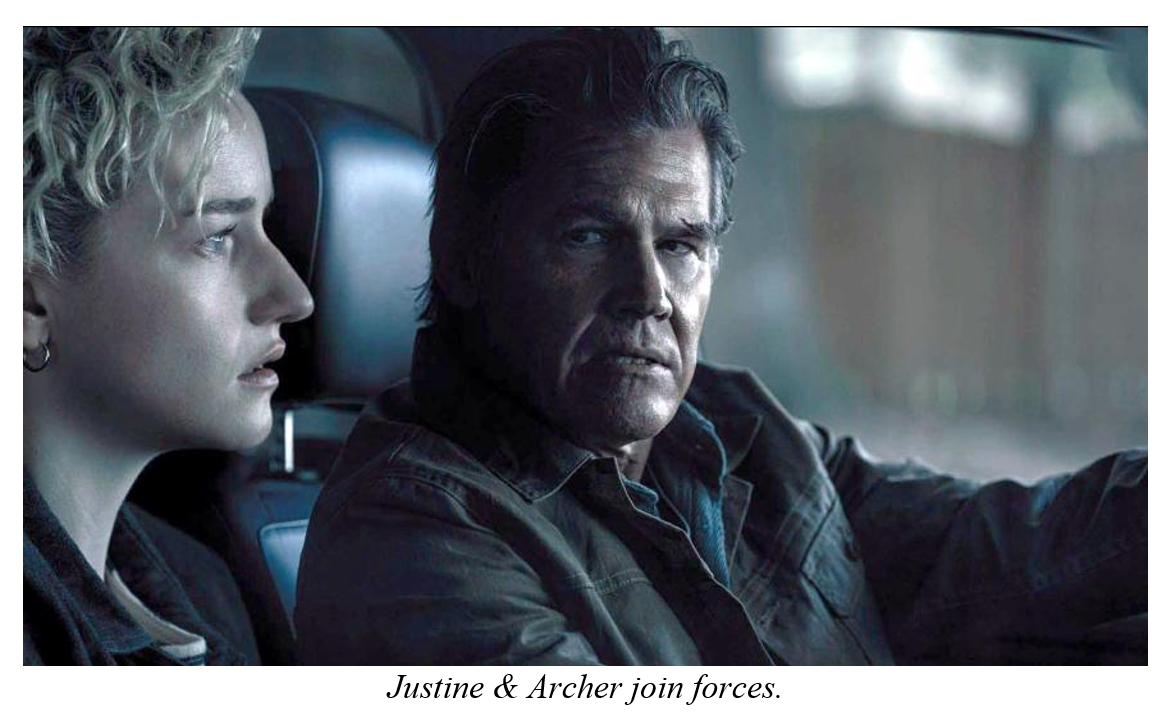
In the film’s finale, Justine and Archer enter Alex’s house. This provides a sufficient distraction to allow Alex to take control of the spell that possesses the children and redirect it towards Gladys herself. Alex aims these ‘weapons’ at Gladys and the children proceed to chase her out of the house and through the suburban neighborhood. As the children smash through doors and windows of houses to get to Gladys, we see her wearing another pink and blue outfit, the last set of clothes she’ll ever wear before her grisly death at the hands of the children who literally tear her apart from limb to limb.
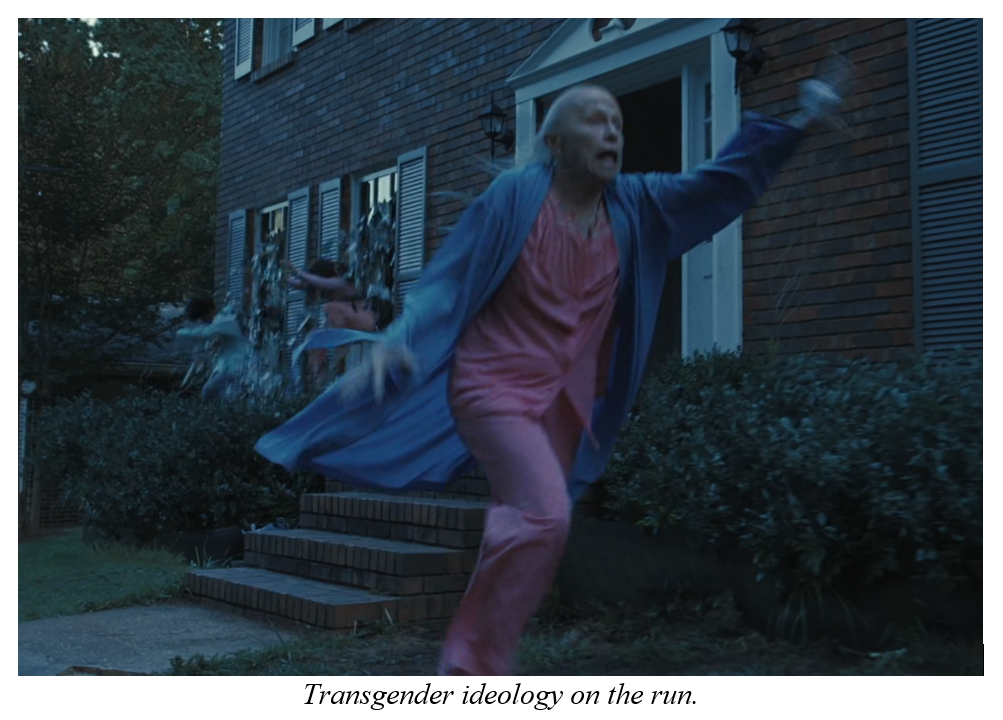
The film ends with the spell being lifted from the children, and most of them returning to normal. A voiceover tells us: “All of the kids from [Alex’s] class got reunited with their parents. Some of them even started talking again this year.” Some will successfully detransition, while others are just too far gone. This finale of Weapons can be interpreted as society’s rejection of the sexual transitioning of minors and of the accompanying ‘liberation’ of children from the clutches of radical transgender ideology.
References
- Belmont, N., Cronin, T. J., & Pepping, C. A. (2024). “Affirmation-support, parental conflict, and mental health outcomes of transgender and gender diverse youth,” International Journal of Transgender Health, 25(1), 50–62. https://doi.org/10.1080/26895269.2023.2252418
- Chichizola, Corey. “Weapons’ Amy Madigan Reacts To Aunt Gladys Becoming A Gay Icon (And She Deserves It),” Cinemablend, November 28, 2025, https://www.cinemablend.com/movies/weapons-amy-madigan-reacts-aunt-gladys-becoming-a-gay-icon
- Earl, William. “‘Weapons’ Director Zach Cregger on David Fincher’s Advice, Sequel Plans and What His ‘Resident Evil’ Movie Will Look Like,” Variety, August 8, 2025, https://variety.com/2025/film/features/weapons-sequel-director-david-fincher-1236468200/.
- Freud, Sigmund (2008). The Uncanny. Penguin Books: New York.
- Garcia CC, Schwarz K, Costa AB, Bridi Filho CA and Lobato MIR (2021). “Perceived Parenting Styles of Individuals With Gender Dysphoria,” Frontiers in Psychology, 12:655407. https://doi.org/10.3389/fpsyg.2021.655407
- Grant, Barry Keith (ed.) (2018). Robin Wood on the Horror Film: Collected Essays and Reviews. Wayne State University Press: Detroit.
- Johnson, S. L., & Benson, K. E. (2014). “It’s Always the Mother’s Fault”: Secondary Stigma of Mothering a Transgender Child. Journal of GLBT Family Studies, 10 (1–2), 124–144. https://doi.org/10.1080/1550428X.2014.857236.
- Jung, C. G. “Psychology and Literature”, in Modern Man in Search of a Soul, translated by W. S. Dell and Cary F. Baynes. New York: Harcourt, Brace, 1933.
- Jung, C. G. “Approaching the Unconscious”, in Jung, C. G., and Marie-Luise Franz. Man and His Symbols. New York: Dell Publishing Company, 1964.
- Lowenstein, Adam (2002). Horror Film and Otherness. Columbia University Press: New York.
- Spandrell. “Biological Leninism,” November 13, 2017, https://spandrell.ch/2017/11/13/biological-leninism.
- Sullivan, Andrew. “How the Gay Rights Movement Radicalized and Lost Its Way,” New York Times, June 26, 2025, https://www.nytimes.com/2025/06/26/opinion/gay-lesbian-trans-rights.html.
- Upadhyaya, Kayla Kumari. “‘Weapons’ and the Demonization of Teachers,” Autostraddle, August 15, 2025, https://www.autostraddle.com/weapons-film-review-queer/.
- Weber, Max. “Science as a Vocation,” in From Max Weber: Essays in Sociology, edited & translated by H. H. Gerth and C. Wright Mills. Oxford University Press, 1958.
- Wood, Robin (1979). “An Introduction to the American Horror Film.” In The American Nightmare: Essays on the Horror Film, edited by Andrew Britton, Richard Lippe, Tony Williams, and Robin Wood. Toronto: Festival of Festivals, 1979. Reprinted in Grant (2018).
End Notes
- See also Lowenstein (2002). ↑
- We can see allegorical anxiety over trans-mania in other recent films such as Ari Aster’s Beau is Afraid (2023) and the Alt-Right-adjacent film Bugonia (2025). In the latter film, which has been nominated for a Best Picture Oscar, the working-class White antagonist Teddy Gatz (Jesse Plemons) has been silo-ed into online conspiracy theories. He believes that some ‘humans’ walking among us are actually Andromedans, wily and capable of using sexual manipulation to achieve their goals. As a defense measure against this, Teddy has undergone chemical castration and convinces his autistic cousin and cohort Dan (Aidan Delbis) to begin doing the same. Dan reluctantly obliges and his subsequent suicide serves as a commentary on the suicide risks of transgender hormone treatments. Teddy and Dan’s pattern of kidnapping and murdering suspected Andromedans may also serve as an allegory about the propensity of transgendered individuals to commit murders in the U.S. ↑
- Cregger has cited Paul Thomas Anderson’s Magnolia (1999) as a big influence on him in the making of Weapons. However, Cregger’s use of this type of multi-perspective device doesn’t entirely succeed here: it feels somewhat forced and the secondary character development is oftentimes pointless to the plot. See Earl (2025). ↑
- The gender divide between parents, which shows fathers least likely to support a child’s transition, is consistently documented. See Johnson & Benson (2014), Garcia et al (2021), and Belmont et al (2024). ↑
- It is worth noting that some liberal reviewers of Weapons see Justine as representing a conservative moral panic, namely, the demonization of queer or trans teachers accused of grooming and indoctrinating students for “simply” discussing LGBTQ+ identity topics. See, for instance, Upadhyaya (2025). ↑
- Various groups in the LGBTQ coalition hold incompatible assumptions about what sex and gender are. Trans-exclusionary radical feminists (TERFs), for example, hold a core position that biological sex is real and immutable. From this foundation, it follows that womanhood is defined by biology and not gender identity. A trans “woman” is biologically male and therefore not a woman in the full sense. In the end, the core conflict is a philosophical disagreement about whether gender is purely a social construct (the trans position) or whether biological sex is an immutable category. The confusing myriad of positions that different groups hold on this topic has led to a proliferation of different ‘pride’ flags. ↑
- The concept originated in the neoreactionary (NRx) online scene circa 2017-2018 and was coined by the blogger Spandrell. ↑
- The role of status anxiety has been central in the theories of various influential sociologists, including Weber, Veblen (conspicuous consumption), Goffman, Bourdieu, and Girard (mimetic rivalry). ↑


